The Rise And Fall Of LUNA: A Comprehensive Analysis Of Its Price Performance

The Rise and Fall of LUNA: A Comprehensive Analysis of its Price Performance
Digital currency is revolutionizing the financial world, offering a speedier, safer, and more open way to transact. Picture a form of money that is counterfeit-proof and trades that take place instantly globally.
The Rise and Fall of LUNA: A Comprehensive Analysis of its Price Performance

The cryptocurrency market has experienced significant fluctuations over the years, with numerous projects tanking or surging in unexpected ways. One such project is Terra (LUNA), which made waves in the crypto sphere with its unprecedented growth and fall. At its peak, LUNA, also known as Terra, was one of the top performers in the crypto market. Like other great stories of financial success, LUNA’s performance however was closely tied with its sister coin which is now known as (UST). Here is a comprehensive analysis of the LUNA coin price, discussing its exponential growth, factors contributing to its fall, and potential future prospects.
Exponential Growth: How LUNA Became a Crypto Sensation
LUNA was launched in May 2018 by Terraform Labs, founded by Do Kwon and Daniel Shin. The project aimed to provide a stable and decentralized cryptocurrency, TerraUSD (UST), which was pegged to the US dollar. To achieve this, the LUNA token was utilized as the governance and collateral token for UST. The groundbreaking idea was to create a stablecoin that was not controlled by any central authority, utilizing a decentralized algorithm to stabilize its price.
As LUNA gained popularity, its value skyrocketed from its initial price of $1.46 to a high of $103.90 in April 2022. This represents a staggering 71,331% increase in just a few months, making LUNA one of the top performers in the crypto market. Analysts and investors were drawn to the project due to its innovative approach to stablecoins and its vast potential for use cases, including cross-border payments and fractionalized lending.
Underlying Mechanisms of LUNA’s Success
Several factors contributed to LUNA’s meteoric rise:
- Algorithmic Stablecoin: UST’s algorithmic design allowed it to maintain a tight peg to the US dollar, which offered a high degree of stability in an otherwise volatile market. This resonated with users, investors, and the broader crypto community.
- PoS Consensus Mechanism: LUNA utilized the Proof-of-Stake (PoS) consensus mechanism, which provides greater energy efficiency and scalability compared to the traditional Proof-of-Work (PoW) mechanism. This drew attention from eco-conscious investors and developers seeking more environmentally friendly solutions.
- Wide Adoption: LUNA gained acceptance across various platforms, including major exchanges, payment processors, and dApps. This increased user adoption, further fueling its growth.
- Decentralized Governance: LUNA’s governance structure, facilitated by on-chain voting, fostered decentralization and allowed the community to participate in decision-making processes. This aspect appealed to advocates of decentralized finance and governance.

The Fall of LUNA: What Went Wrong?
However, in May 2022, the beginning of the end of LUNA’s performance really became apparent after some liquidity was drained from the 38 billion dollar UST purse due to minor usage of the stablecoin by developers. Although that action may be seen as fairly insignificant for normal cryptocurrencies it did bring massive issues in LUNA’s price drops.
Its usage spread at early levels and it had not been effectively tested as a stable and reliable currency, but since that event more UST was being constantly created leading by an algorithm which held the ‘stable’ currency’s value at around the dollar mark.
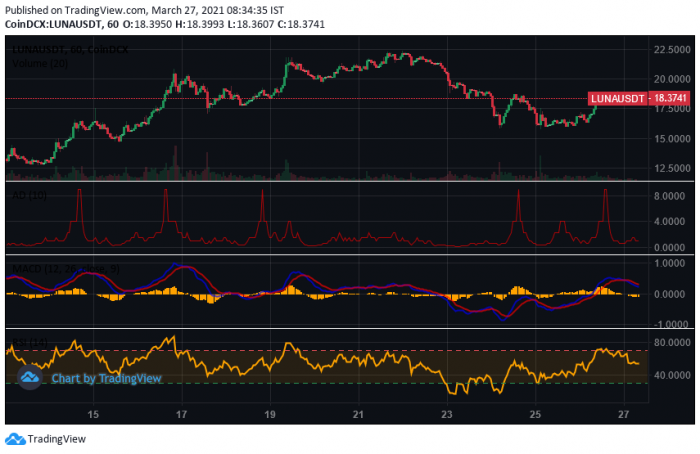
Investors scrambled to withdraw their money from Terra-based platforms as the price of LUNA plummeted. Market sentiment shifted rapidly, and UST’s price began to deviate significantly from its peg, causing a vicious cycle of redemptions and further price drops.
Reasons for the LUNA Price Drop
Several factors contributed to the drastic decline in LUNA’s price:
- Cracking of Algorithmic Stablecoin System: The Terra algorithm, responsible for maintaining UST’s peg, was deemed unstable and failed to withstand market pressure when investors began withdrawing their funds.
- Massive Redemptions: Investors rushed to withdraw their money from Terra-based platforms, further eroding the value of UST and LUNA.
- Market Sentiment Shift: Market participants turned bearish on LUNA due to UST’s deteriorating price and potential risks associated with the cryptocurrency.
- Competition from Traditional Stablecoins: Established stablecoins like USDT and USDC drew users away from UST, further exacerbating the slide of Terra’s market share.
%20[15.47.23,%2003%20Feb,%202021]-637479606334079027.png)
Investigation and Action Taken
Terraform Labs, the creators of LUNA, faced intense scrutiny and allegations of deception, lying, and theft of money from the people using these instruments. Investigations were initiated by authorities from Australia to South Korea, but these proceedings saw little development and ended without proper close down on the system because the major system responsible is operated within the U.S, terra’s representative of the U.S. firm did however, agree to offer more insight into these investigations as they were ongoing.
Post a Comment